Friday, February 8, 2013

The Startup CEO #4: Restraint

In 1987, at 185 lbs I was perhaps the lightest pulling guard in college football.  But as a wrestler and a physicist, I knew the secrets of momentum, leverage and timing and so I could generally block most of the lard-balls I faced, even though they often weighed 100 lbs more than I did.  This was club ball.

Sometimes it took a few seconds to get them where I wanted, or at least to move them away from where I did not want them.  We had a wonderful tailback who could read the development on the line like a top skier does a mountain, and would hold back and then scoot through even the tiniest of holes, breaking out into the secondary more often than not.  I loved him.

One day at practice, there was a clean cut, tanned man wearing a Carolina Blue golf shirt watching us and taking notes.  He showed up again the next day, and then again at our game on Sunday morning.  The next week at practice, half our guys didn't show up, and we found out that Mack Brown, who was well on his way to his second 1-10 season at UNC, had had a mutiny among his own players and drafted the best of ours (but not me).  Our tailback was gone, and so our fullback moved back, and he read the line in brail with his shoulder pads and helmet, leaving me with bruises and footprints all over my backside as I got caught between this warthog and the lard-balls over and over again.

Another Example


A little over two years ago, about the time I started this blog, I prayed and asked God to fix my company.  The board had degraded into a cesspool of factions each pushing different agendas with telephone trees to their list of supporters, and secret investor meetings that everyone knew about and nobody attended but which had acrid minutes that were passed around in chain emails.  The employees were still doing their best, but funding was difficult in 2010, and every potential investor could see the troubles on the board, and they were shying away.

I trusted that God was still God and had heard my prayer and would act on it when it was His will to do so. So I put one foot in front of the other and tried to do the right thing and the best things for the company, and waited.

In November 2010, I was relieved of my position. 

I was without a job, was owed $70,000 in back pay and expenses, had a mortgage and small children who needed to be fed, and the company was refusing to honor my severance package.  But God is God, so I put one foot in front of the other and cut back on everything except our donations to our church and some local charities, and began to think about what I might do after Innegrity.

Within a few weeks I was approached by my current partner with the idea to form Dreamweaver, and after I researched the patent landscape and the technology and the market opportunity, I began to draft a business plan, and we started the company almost exactly two months after I was fired from Innegrity with nothing but an idea and Jim's good intuition.  I put my nose to the grindstone and studied and ran experiments and tried to learn quickly what went on inside a battery under different conditions, and how it could be improved by making paper with nanofibers.  I was way out of my element, but learned fast and within six months we had built a tiny little hearing aid battery that seemed to show some promise, so we started the process of raising money and building a real company.


Restraint in a Startup


Working with Jim is a dream for a young CEO (well, COO) like me.  You see, when I walk into my closet to get dressed in the morning, I know what the wavelength is for each color and how colors mix to form other colors and why some materials shimmer and others flicker and others are bright and others dull--but I still have to ask my wife if a sweater matches my shirt.

Jim has a few phrases that he applies over and over, and I've noticed that they have more to do with what we choose not to do than with what we choose to do.

"If you lie down with dogs, you're bound to get fleas."

"Talk is cheap, but money buys the whiskey."
"Only a few things are going to ring the cash register."  
By listening to Jim's advice, I am learning not to lay down with too many dogs, not to waste too much time with people who talk a lot but won't back up what they do with actions or money, and also not to spend too much time on stuff that has little chance of ringing the cash register.  Here are a few practical examples:

  • Choose partners carefully:  Jim and I discuss every new addition to the company, be they a supplier, customer, employee, manufacturing partner, test lab.  Some we choose on technical ability alone, but most also have to fit our culture, to fit our bias for action and have the right expectations.  It is arduous and we leave some good people behind, but it really is about finding the top few percent that will work, and leaving behind everyone who even has a hint of being an A- fit.  Something that does not come easily to me, but that I'm learning, is leaving behind good technology in companies that are populated with people who won't execute.
  • Not all investors with money are good investors:  We screen and screen and screen and in general have avoided most financial investors as being people who would not have a chance of understanding our business.  Our supporters all have an operational background and understand the slow and arduous process of developing and commercializing a material that can be a real change agent in a "fast moving" market.  Only a few financial investors have made the cut.
  • Delivering value to the customer is everything:  We spend an inordinate amount of time, and I am flying and driving all over the world to really understand the intricacies of what our customers needs are and how their decisions are driven.  It took almost two years for us to decide how to position our product (the lowest cost high technology battery separators in the world), and we are still exploring the dynamics of the process to get placements.  This market is big, and we can make a lot of money in it, but first we had to learn with a high degree of precision what it is our customers value--what combination of product and service will make them part with their hard-earned money to include our product as a component of theirs.
  • Don't make any major decision until you have to:  We didn't price our product until we were about to take an order.  We still haven't priced our second product.  We have resisted adding people to the board, adding advisors, choosing materials, deciding how to market in other regions.  In each case, we are studying the market and the other options before deciding how to position ourselves.  Every decision is made with the customers' best interests in mind, and so we gather and gather and gather information so we can make the decision that will serve the customer in the very best fashion.
I think it's clear, but I love working with Jim and his participation has helped give Dreamweaver a fighting chance of becoming one of the best new advanced materials companies in our industry.
 

Monday, December 31, 2012

New Year's Resolutions

As the family is packing up decorations from our month of celebrations, and the kids are upstairs playing in the play room, I am reminded how very blessed I am to be surrounded--literally surrounded on all sides--by such love and happiness.  In this time of peace and thanksgiving, it is good to ponder on what things I should focus in the coming year.  I have chosen three:


To be generous and kind


I am normally able to be generous with things.  Mandi and I welcome others into our house frequently and we share what we have.  I tend to do this on my own terms, though, and so I will look for the opportunities God may put in front of me to challenge the boundaries of our generosity.

One area where I can be quite stingy is with my time.  While sometimes I give freely, it is often for my own purposes and I will also squander it purposelessly.  Here I will focus on giving this precious gift from God freely to others wherever I am able to help.

Kindness is another story, and applies to me only sporadically.  I admit I can be quite hard, and this is not what we are called to be.  This doesn't necessarily mean I need to change the purpose of my actions--children still need to be punished, directions need to be given, negotiations finalized.  Rather I should learn to do things in a kinder, more gentle way, giving my children and others who look to me an example worth following.  I do not fully grasp the effect I have when I am too stern, and so this is a real opportunity to make changes that will have a lasting effect on the people I interact with, be they family, friends or business.

To do everything I can to put my family and the company I serve on firm financial footing.


God has been extraordinarily generous to me, taking care of me and my family through the downturn and through a change in employment that, because of it's timing, could have been quite tumultuous.  He calls us to be responsible stewards of what we have been given, and I have stewardship responsibilities in both my family and business.

There is no disguising that this will require hard work and sacrifice, but if I do things right and follow the path that God teaches, it again is an opportunity to make changes and put structures in place that will have a lasting effect on my family, the company I serve and the people associated with it, be they employees, partners, investors, customers or suppliers.  It is a time to de-risk both my family and the company.


To understand how agnostics and the early Christians came to their beliefs


I read the Bible nearly every day, I teach my family, I go to church, I pray frequently...and yet there is in me a deep-seated independence that defies all efforts to harness it.  I don't disbelieve God or anything He says--He has been too persistent in his love and tender care for me--but there is a rebellious nature in me that makes me occasionally throw down the shackles and run away, even if for just a little while.  Sometimes I even get jealous of Him, and talk to and treat Him as an equal.  This isn't right.

An equally strong and persistent urge has been a life-long search for the truth.  It is what led me to God--He is "the Truth."   I plan to make a study of how the early Christians came to their understanding of God, from first principles and early documents.

On the other side, the Bible clearly says that we cannot know God through human wisdom (1 Corinthians 1:20-23).  There are some very smart people who seriously address the question of God and get stuck at exactly this point: they acknowledge His existence, but do not come to know Him.  Are they turned off by the church and organized religion and so reject it in favor of a home-grown version?  Can they not make a decision between the different religions?  Is it just laziness?  Fear that they might lose their self-primacy?  Is it an absence of the Holy Spirit in their lives--were they not selected (Romans 9:24)?   Other than the absence of the Holy Spirit, I have been in all of these places--perhaps agnosticism is simply the batter's box for Christianity?  In any case, this is a question I intend to ponder this year.

I don't know if either of these will help tame the tiger within me, but I do believe some good will come of it.

Sunday, December 16, 2012

The Startup CEO #3: The Nexus of Competence

When I was twelve years old, I studied to be an expert at splitting wood.  I studied the grain, the dryness, the number of knots. I placed the wedge where I thought it would split easiest, and tapped the wedge in, and even planned when I would snap my wrists while swinging the sledge, when I lifted with my legs and how I put my back into it.  I rejoiced when the wedge sailed through cleanly.

Parents, do not deny your children the wonder of hard work.  I did none of that willingly, but it taught me excellence and gave me trunk strength that made me the best 185 lb pulling guard in college football. :-)

There were times at Innegrity when I was startled by the excellence of the people around me.  They had such skills and raw talent, could manage customers and make material and build parts.  They made the company go!

The Nexus of Competence


We had a board member at Innegrity, a gentleman who had started at Milliken, then become CEO of a large textile company, the sold the company and moved on to get a PhD in business and become a professor of strategy.  He captured strategic leadership in three words: Character, Competence and Community.  When I asked what the leaders had to be competent at, he replied first that they should always continue to learn, to never be satisfied.  I joked that academics could do that, so he then gave a definition that said they should learn a little of everything--operations, sales, product development, marketing...  I challenged him again, "How much of this do I need to know, versus having a team that has that competence?"

Les is not someone who struggles with clarity, but we finished our conversation without a clear answer.

Often small companies are spread so thin that everyone is a front line contributor, and it's not uncommon to hear of leaders who are packing orders or cleaning bathrooms.  Where they contribute isn't all that important, and I've seen leaders who were excellent technically, who were accountants, who had great organizational skills, or who were salespeople or marketers.

In a small company, people don't care what the leader can do, but the company will live and die on what they believe the leader can get done.  They rely on the CEO to ensure that the product is designed perfectly, that the product is made flawlessly, that it is shipped on time and in good shape, that the company will be financially stable, that the investors will not interfere with the company's operations.  The CEO is the one place they turn for all of this. 

It is not enough for the leader to be believable.  There are people who have the talent of being believable, but that will break down over time.  Rather, the leader must actually ensure competence, and in time it will become believable.  Causality here is very, very important.

This is the Nexus of Competence:  a customer or investor or employee must be able to rely on the CEO to get things done.  The CEO builds credibility by building a credible organization--but the credibility absolutely begins and ends with her.  She has to make sure things happen as designed.  This is a role the CEO cannot delegate.  The trains must run on time, or the company will fail.

How it Breaks Down

It is clear that at the end of my time at Innegrity, the Nexus of Competence broke down.  The environment was very difficult in 2009 and 2010, and the business was building more slowly than we had hoped.  We went from one end-user at the beginning of 2009 (the Brawn Formula 1 team--now Mercedes) to 18 end-users at the end of 2009, and 60 when I left in November 2010.  The last contract I signed was with Head Tennis Rackets, and both the first and last contracts produced world champions.  But product sales had only brushed the underside of $1 million/year and were choppy and unpredictable.  Most of the applications were small sporting goods applications--we had yet to land a big ballistic contract. 

People were growing frustrated and looking over each other's shoulders.  Our salespeople questioned the quality coming out of manufacturing.  The manufacturing guys asked for a few sales accounts, thinking they could do better.  A few investors became very active, questioning everything and calling for change.

The important point here is that the breakdown wasn't in the competence of the organization--there were a few mistakes, but the organization was producing a quality product, getting it into customers' hands and those customers were adopting it and launching new products at a very fast pace.  The breakdown came when everyone questioned everyone else, when people's arrogance and pride helped them become "experts" in things they knew nothing about.  The unknown became a source of paranoia that took hold like a virus.

The competence did not break down--rather it was a breakdown in the confidence that others had in that competence--a breakdown in the Nexus of Competence.

I describe one of my principle skills as a CEO as having a very deep keel.  I don't get rattled by the rough seas, and can stay on path even as others waver.  This confidence is contagious, and allows me to form the Nexus of Competence--I provide a vision, I solve problems, I help the team to function and to keep focused.  Others believe in me and in the competence of the team, and the ship holds together.  This comes with its requisite number of sleepless nights, early mornings and lots and lots of prayers.

My Personal Story


I am continually humbled by those who join when I start something new.  It's not something I deserve or could force, and so much more gets done because these people join.  Most of the time it happens in an informal "what are you working on," "oh, just this," "that sounds interesting" "it's great" "how can I help" conversation, which ends with someone else joining in and me going to bed thanking God for the people he has surrounded me with.

I hate that I was not able to hold Innegrity together at the end--that the same people who risked a lot to join began to question each other and, eventually, me.  My only consolation is that, compared to what came after I left, we were a model of competence and efficiency.  That does not alleviate the breakdown in confidence others had in the team under my watch.  Now that I have been given a second chance, I am being ever so more careful and diligent to make sure that we both far exceed the competence of the last time, and also do not put ourselves into the risky situation that we were in before, with high costs and not enough revenue.

This puts me in an interesting predicament--my job is to ensure that everyone has confidence in the team.  Yet I am already and continually humbled by the confidence already shown.  So I work ten times as hard to help the team live up to their expectations to ensure that the confidence is not ill-placed.

Saturday, November 10, 2012

The Startup CEO #2: The Perfect Product

There are people who's personalities are so powerful, so compelling, that they can bluff their way through almost anything.  This powerful personality is common among startup CEOs, and it is not uncommon for the Startup CEO to get confused between the actual prospects for his product and his own enthusiasm. This is a particular weakness for me, and sometimes when I get carried away, I'll just announce that "I'm a pathological optimist so you have to evaluate this yourself!"

Our Imperfect Fiber


I've talked about the decision at Innegrity to make a large capital investment in 2008, and how I would like to have done things differently.  The fact is, something had to be done.

We had built a pilot plant on a shoestring budget, and somehow made a product, and that product did some wonderful things like stop bullets and make carbon and glass composites light weight and tough as nails.  It had been made into things from surfboards to Formula 1 parts to ballistic shields.  Here is a video I love.

My team had talked with many customers and had, through the compelling vision of the product and the relationships they'd formed, convinced them to make production fabrics, coated fabrics and products.  It worked well in the applications but it had a flaw--it was tough to weave.  It could work, but it was an unpleasant hassle.

This feedback came from a number of different sources and we triangulated it through the value chain.  It is never as clear as in hindsight, but we determined that this could not be overcome with marketing, sales personalities or packaging, but was instead a real problem that had to have a real solution, fast.

We inspected our manufacturing process and corrected as much as we could.  We searched the value chain for help, both for our customers and to fix the problems with our product. I talked to people on every continent, and traveled all over the US and Europe looking for a solution.

We found a solution in the form of a new machine from Germany.  Over the course of 2008, they convinced us that they new machine would solve the problem, and by early 2009, we had bought a machine and formed a joint venture around another, and our product was pleasantly weavable.  Thus began the long, 22 month trek from one end-user to sixty which ended a little short of the finish line, with my termination from the company.

The Perfect Product


It's difficult to describe the soul searching that went on.  Everyone had an opinion, not just on the problem, but on the customers, their abilities, and the potential solutions. Some employees wanted to cut corners.  Some customers said it was okay.  Some end-users said they could force the weavers to do what they wanted.  Some markets didn't need it as badly.  In making the decision, I took all the facts and opinions and the sage advice from my management team to my office and closed my door and had a conversation with my Maker, and made the decision that the product could not be compromised.

If I had made a different decision, Innegrity would have been a technical success, but a marketing and financial failure.  At the end of my time, with 60 end users active and more signing up every month, it was a technical and marketing success, though still a financial failure. 

In Steve Jobs biography, he is described as being fanatic about the tiniest details of his products, often demanding entire redesigns at the last minute.  This happened with the Mac, with Pixar movies, the iPod and the iPhone and the iPad.  Bill Gates was the same, if perhaps a little less original. 

Perfect Product people change the world.  They make products that are so compelling that we flock to them--iPhones, Windows, the Model T, the light bulb, Sheetrock, the pneumatic tire...the list goes on.  They can be materials, too:  Teflon, Kevlar, Styrofoam.  Or they can be devices:  the transistor, integrated circuits, the laser.  So many people downplay the old cliche about the better mousetrap--a better mousetrap isn't worth a crap.  But a perfect mousetrap?  People, mice, cats, and the rest of the animal kingdom will beat the path to your door, as has been proven time and time again.

The Startup CEO cannot delegate this, and she cannot compromise it.  It is not the job of the CTO, or of the CMO.  Without a flagship product that nears perfection, the startup will fail.

The External Truth


The Perfect Product cannot be compromised, and no magnitude of a compelling personality can overcome a products flaws.  The product must stand on its own, and this is one of the primary roles of the Startup CEO.

I love this.  Seeking the Perfect Product is seeking an external truth, and in that way, it is worship for me.  "I am the Way, the Truth, and the Light," said Jesus.  And so all the hard work to find the flaws, to understand the customer, to bend the technology--all of this is for me is seeking Truth, seeking Jesus.  He knows where my heart is in this, and that is enough.

Thursday, October 11, 2012

The Startup CEO #1: Daring Greatly

"Daddy, could you come protect me from bees while I get this apple," Alex asked me.

"Certainly," I told her.  "I am a great protector from bees."  And so she took my hand and pulle me into the apple tree, with bees bzzzzing from one fallen and rotting apple to the next, gathering whatever it is they gather that eventually turns to honey.  With some lifting and climbing and one "swish!" at a bee that got too close, she gained her prize--a golden delicious apple that was a little bigger, a little plumper, a little juicier than the others.  Then it was down and off to the next one.

In this next series of posts, I'd like to talk about the core functions of the startup CEO.  In some cases, it will be the actual activities of the CEO, in some cases responsibilities--what I really want to capture is the essense of those things that can not be delegated, that fall foremost and only into the lap of the CEO, that she and she alone can cause to be accomplished, and that without her will fail with absolute certainty.

Daring Greatly

The first has been described quite well in a quote from Theodore Roosevelt:
It is not the critic who counts: not the man who points out how the strong man stumbles or where the doer of deeds could have done better. The credit belongs to the man who is actually in the arena, whose face is marred by dust and sweat and blood, who strives valiantly, who errs and comes up short again and again, because there is no effort without error or shortcoming, but who knows the great enthusiasms, the great devotions, who spends himself for a worthy cause; who, at the best, knows, in the end, the triumph of high achievement, and who, at the worst, if he fails, at least he fails while daring greatly, so that his place shall never be with those cold and timid souls who knew neither victory nor defeat.
 And so the startup CEO must Dare Greatly; she must be in the arena, with dirt marring her fingers and sweat traversing her brow, making things get done that otherwise, without her courage and pathalogical fearlessness, would go undone, would fail unaccomplished, would wither unnourished.

The CEO must choose these great goals, and this is not about the distinction between organizing the world's information, putting a computer on every desk, stopping bullets, solving the world energy crisis, increasing marital harmony, bringing people to God, or other great tasks.  The question here isn't the direction of the walking, it is the length of the stride.  And that stride must be GREAT!

How to do it Wrong

In my early career, my work on many projects made tiny strides:
  1. Reducing the dust on wipers for cleanrooms.
  2. Adding the ability to put a color pattern onto the seat backs of cars inexpensively.
  3. Making a small, strong fiber to reduce weight in technical apparel fabrics.
  4. Making a smaller fiber that felt nicer in apparel fabrics.
  5. Making a carpet backing that would go a little longer before it had to be restretched.
  6. Making fiber process faster.
In each of these, there was the potential to make money, and in some cases, a lot of money.  But each was a nuance on what had come before, something that people might pay for, but otherwise would make very little difference.

I can remember one instance in particular where I was championing an innovation that a group of us had had.  John Rekers, the Division President for the Chemical Division at Milliken, had asked us to make a 50% improvement.  We had achieved about 30%, and I was challenging him to declare it "good enough," and let us move on with commercialization.  John didn't answer my challenge, but rather turned the question to me, asking how we could make it better, how we could reach farther, improve it further.  What had we left unexplored?  What paradigms had we not challenged that would uncover the key to making this bigger stride?

After I left, this group did achieve their 50% improvement, and did launch a product, and it appears from the outside to be doing quite well.  John had the capability to demand great strides.  This example illustrates clearly the leader he was, and that I wasn't.

One way to do it Right

Early on at Innegrity I knew the fiber was really different, but I was still trying to use it to make canoes and kayaks a little lighter or a little less expensive.

During this time, two people ask me the same question in different ways.  One asked if it could work to make the fastest, most highly engineered cars in the world perform better.  I said no, I didn't think so, but he asked if he could try anyway and I told him go ahead.  He did, and it made the cars lighter and the team we were working with went from 9th to 1st (of 12 teams) in one season using our fiber, and that became our first commercial success. 

The other person asked if it could be used in ballistic protection, and I said no, probably not, it's not strong enough, but go ahead and try.  I can still remember landing on the tarmac at Reagan Intl Airport and trying to look at his data on my Blackberry and almost falling down the stairs with my VP Sales as we could not believe that it had outperformed Kevlar in many ways.

These two innovations--combining the fiber with carbon fiber in composites and combining the fiber with aramid (Kevlar) fiber for ballistic protection--form the cornerstone of Innegra's success.  As a practitioner, I said "No, don't bother."  As a leader, I asked, "Do you really think so?" and "What would happen if it were so?" and I created an environment and gave them the time and resources to try, to Dare Greatly, and when they did, I helped to leverage their success into many more successes, and ultimately turned a spongy little fiber into something that has won multiple world championships in several different sporting arenas and has been placed into a position where it can save lives. 

One Difficulty

As Mr. Roosevelt pointed out, one difficulty with Daring Greatly is the critics.  I used to joke that in some venues, the smartest people in the room are those who are able to articulate their ignorance most eloquently.  "I don't know if we have properly considered the consequences of implementing such a technology, and whether it might cause great damage if it were in such-and-such a situation about which we have no knowledge at all!"

At its best, this criticism is a background buzz that nags and slows and builds unnecessary fear, hindering the feet of those who would take great strides, causing their steps to shorten and their footing to grow less sure.  At it's worst, the critics take up the mantle of a crusade to destroy change, pouring energy and resources into building fear and breaking down what strides have been made. 

In the end, the leader has to understand the cowardice that runs through the veins of "these cold, timid souls who know neither victory nor defeat," and stride on anyway.

A Postlude

Alex picked her apples.  She climbed her trees and selected the ones that were just so.  Later, she rode on a hayride and dressed a scarecrow and played and jumped and ran with her brother.  Then, when we sat down for lunch, she did get stung by a bee for the first time in her life and cried great tears with big belly whelping sobs erupting like so much lava.  An hour later, she was laughing at her stoopid daddy who told her that when he was a boy, he would shake bees in a jar to make them mad and then open the jar and run off, and sometimes get stung.  When we got home, she ran next door to tell our neighbors about her sting and get their hugs show her wounds.  But she still has her apples and she knows the joy of climbing and selecting and riding and dressing and running and playing, and she knows how little to fear the bzzzzing and even the stinging of the bees.

This Daring Greatly is not the doing of a practitioner, though it can be.  Rather it is simple, raw courage to break free of the world of the so-so, the hum-drum, the same-as-yesterday, and create something new--and not just a little new but Greatly new.  This Daring Greatly cannot be delegated, it cannot be assigned, and without it any startup is doomed to mediocrity. 

Sunday, September 16, 2012

Product vs. Process #4: Low and High

God, for me, has been a constant tugging, like gravity--never going away, but never overpowering in such a way that it can't be resisted.  Just like I can climb trees, I can resist God.  But like water seeks it's own level, so He always brings me back. 

In college, if I were at a party and there were two conversations--one about football and one about God--once I knew the score I would turn toward the one about God.  If I went on two dates, one with a beautiful lady and one with a Godly lady, the first might have momentary alure, but the second would have more pull, leave me more curious, wondering more, more desirous.  This has been true for as long as I can remember.  I've never had a moment where God was overpowering and transformed me.  For me it was more like having many smaller moments, each one chiseling this rough-hewn stone that is my soul. 

Sin, on the other hand, is not constant.  There are times in my life when I am devoid of it, when there is love and there is companionship and there is serenity.  For me, sin is related strongly to proximity.  If I go where sin is then it can grip me and grab me and gravity can be overwhelmed for a while.  If I am where it is not, then the appeal is much less, maybe nonexistent.  So, as an adult, I don't hang out with attractive single women, I avoid belligerent people, I don't participate in much drinking, I watch movies without nudie scenes, I read books primarily about history, business and God, and I don't shop in stores where I can't afford the stuff.

These are some simple choices that I can make.  Later, I'll talk about the more difficult areas, but first, some...

...Other Choices:  Low Process, High Product Innovations

Don't even think about starting a materials business in which you are required to build something to get the initial sale.  It's a choice, and if you get halfway through writing the business plan and there is no way to avoid building--chuck the business plan and think of something else.  Here is why high product, low process innovations are much better:

R&D:  The R&D is fast.  If your innovation can be implemented on standard equipment, that means  someone owns standard equipment that you can do R&D on.  Rent it from them, rent their technicians if you can, and do the R&D by bringing in your own starting materials and making your samples and taking the results away with you.  Likely, you'll have to work with two or three labs and no one will have the full picture except you.  Having to build a lab with lab scale prototypes and hire a staff to figure out all the problems can take five times as long and cost five times as much.

Patent Protection:  Patents are what you will sell.  File reams of them and document your trade secrets.  Sign secrecy agreements with everyone who touches the material until you are ready to launch a product. 

Outsource Manufacturing:  As soon as you have a prototype in the lab, find somewhere to make a bunch of it.  Again, someone who owns this equipment will rent it to you, especially if its a good, growth market and they have a chance to be a long term partner.  Often, there will be pilot scale equipment available for rent with no long term expectations, and this may be better for the first tests.  Make enough material to test in full scale applications and for customers to test on their production lines.  Iterate a few times, and document everything.  You didn't have to build a production machine or even a pilot line, and you don't have to hire any full time staff for this, though an extra scientist to help understand things is helpful.  Without exaggeration, outsourcing can save you three years and $3-5 million dollars.

Business/Application Development:  You want to get here, where the heart of your business is, as fast as possible.  Get your product into customers hands and get their feedback.  Expect your first prototype to have flaws.  Your goal initially is to find out what the flaws are and fix them and get new, significantly improved products into their hands quickly.  It is not a numbers game, so hire a couple good technical sales people who can listen, ask the right questions, get feedback and find the right applications for your product. Don't hang on one or two big customers--look for 6-10 who will test your product and give honest feedback fast.

You have a huge benefit here when working with other people's R&D facilities and other people's manufacturing facilities, in that you can iterate a product very quickly.  Absorb your customers feedback, fix the problems and get it back into their hands.  Expect to iterate a few times and don't believe any of the crap people will say about not being able to go back to the well a second time, etc. etc.  Customers love a new supplier who brings them something innovative, listens to their feedback and quickly brings an improved product.  Even if they have to iterate a couple times, they will continue if they have a problem you can solve.  In this sense, you are free R&D for them, and most customers expect to use their supplier base for this.

If, on the other hand, you have a product that has a high process innovation component, you may have to rebuild the machine.  This can take 6-12 months and cost a lot of money--at least $X00,000s and maybe $X,000,000s.  Without the machine, it is limited by your time and could iterate as quickly as a month or two and for a few $X0,000s.

The Challenge:  The challenge with innovations like this is that it may be easy to steal or to invent around.  There are ways to mitigate this, and they include:
  • Patent Protection:  File early and often.  This will protect you in honest countries and from honest competitors, and that is a big help.
  • Trade Secrets:  Find a critical component--often the details required to scale up production--and keep it secret.  Document what the trade secrets are, and who knows them.  Most states have pretty strong trade secret law, with stiff penalties for employees or ex-employees or partners who violate them.
  • Choose Partners Sparingly and Wisely:  Choose your R&D, pilot and production partners carefully and develop lasting, long-term relationships.  Ensure they make money while you do.  In the end, non-proliferation will depend on only a few people really understanding the innovation.
  • Sell Quickly:   If your invention has real value, eventualy someone will cheat, invent around, or knock off your material.  If this is done honestly, it's okay and a little competiton is good.  Even honestly, if your company is still small and it has been knocked off by Dow, then sell quickly to DuPont and move on to the next invention.  Take the bird in the hand, roast it and enjoy it's succulent flavor, even if you are certain that a bigger, juicier bird is nesting in the next tree.
The Benefit:  There are many companies who rightly see themselves as being very, very good at business development, but aweful at real innovation. These companies look for products they can buy that will leverage the long reach of their business development relationships and otherwise require little up-front investment, other than the purchase price for the technology. 

This Doesn't Make it Easy

Even choosing the right type of innovation, which gives access to a more nimble business plan, doesn't make it easy.  There are technical problems with fitting your work into other people's agendas, with working on equipment you don't own and can't easily change, with building relationships and finding partners whose priorities fit your goals.  In the end, the product has to work, and it has to create much more value than it costs to produce.  If this is the case, a lot of other problems go away.

In the same way, though I can make choices that help me avoid sin, there are other sins so deeply ingrained in my person that I can't get away.  My particular weakness is what I call self-love, and it is steeped in pride, arrogance, a need to be right, sometimes being unnecessarily quarrelsome, and having a deep rooted insecurity that can leave me putting others down and not appreciating and loving others because of this weakness in myself.  Getting away from this is more complicated than closing the book or walking out of the room or movie theater.   Like the high product, low process innovation company, it has to do with building lasting relationships--with God, with my spouse, my children, with accountability partners and others who care enough to help me overcome these weaknesses.  And in the end, if my relationship with God is strong enough, a lot of other problems go away.

Sunday, August 26, 2012

Milliken v. Morin, reprise

Sometimes we can find a cross in places we would not normally look--in the intersection of a window sill and the vertical of a building behind it, at the disection of a high tension electrical wire by the vertical of a tall pine tree.  I think God places them there often and I miss them.  When I do see them, these crosses remind me that, despite all the things that go on in this world--including my participation--its Creator seeks love, justice, and in the end all will be made right.

Here is a place I have found an unexpected cross.  

Milliken vs. Morin in the South Carolina Supreme Court

First, please understand I am not a lawyer and so am writing my own unprofessional opinion and observations.  If this posting or its content has any meaning in your life, I suggest you get an attorney as the subject matter is quite confusing.
 A couple weeks ago, the South Carolina Supreme Court issued their opinion on Milliken vs. MorinThe opinion can be read here. 

They "AFFIRMED AS MODIFIED" the prior court's opinions.  Let's be clear, here:  I was asking them to overturn the jury's verdict as a matter of law.  They declined to do so, which in every day language means that I lost and Milliken won.

The justices begin their comments on page 11 with:
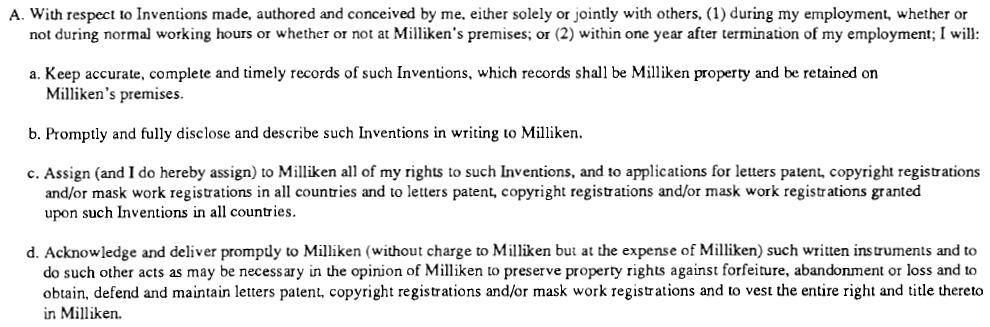
The invention assignment agreement Morin signed is embodied in a complex set of paragraphs which by no means are an exercise in clarity. After sorting through the morass, however, the impact of the agreement is much narrower than it may appear initially.

There are three important clauses:

Together these are pretty broad.  But on the next page is this:

These make up the "morass" that is "by no means an exercise in clarity" and "much narrower than it may appear initially." 

Back in college, I had a class in Digital Circuits so I thought I knew something about AND and OR gates, but admittedly can get confused with a complex series of nested AND, OR, NOTAND and NOTOR gates. 

In this picture, the big blue circle is all inventions authored by the employee.  These belong to Milliken, except what is excluded by the exception.  The exception has phrases A, B, C1 and C2 represented by the red, purple, and two green circles.  I had thought the exception applied to inventions which satisfied

A AND B AND (C1 OR C2)

Now look again at the picture.  In my interpretation, the exception would include only the little quadragonal type shape and the tiny triangles next to it--a little rabbit head--everything else in the big blue circle belonged to Milliken. The justices state early that:
This argument is based on a misreading of the agreement.
In their opinion, they state:
Under the terms of the agreement, if the invention either does not relate to Milliken's work or was not the result of work performed by the employee for Milliken, then it is not covered.
 This is broader than the little rabbit head.  The justices go on:
Conversely, for the exception to not apply— and thus require assignment of the invention—it must both relate to Milliken's business/research and result from the employee's work at Milliken.
Then, to leave no ambiguity, they add:
Thus, so long as the invention does not relate to work performed by the employee, it is not to be assigned.
So the exception applies to everything except areas that are both related to their business and result from the employee's work at Milliken.  In this picture, both green circles are now excepted from the assignment.  The exception applies to inventions which satisfy
C1 or C2
For complete clarity, they state:
Under general principles of contract law, we find first as a matter of law that this agreement is unambiguous.
To be clear here--this is not a criticism of the Justices or their ruling.  In a complex nesting of logic gates there are plenty of ways to cancel one with another and it's honestly beyond my capability to understand whether you can get from the "morass" to where they arrived.  They did; it is now law.  That is fine and just and good and I would expect no less from our court system.


A Personal Note


A portion of my life has been scrutinized through the lense of this agreement for seven years.  Every word in thousands of pages of notebooks, emails, notes and correspondence were held up to the standards laid out by this "morass" that is "by no means an exercise in clarity." 

All of this was presented to a jury and they found that my actions did not live up to this standard.  I only got a B+ in my Digital Circuits class and trust in the wisdom of the jury to have hit pretty close to the mark.  They found that I had caused $25,324 of damages to Milliken.  It has been paid. 

To obtain this verdict, Milliken expended valuable resources (likely millions in outside attorneys, plus internal resources, but it could be less or more).

And now we find much of what we argued about was "based on a misreading of the agreement," and that "the impact of the agreement is much narrower than it may appear initially." 

God is in there, for sure.  Using this thing to work on both sides, I believe.

Many people have hypothesized what purpose compelled Milliken to expend these resources.  Most fall in three categories:  1) that the inventions in question are so valuable that the chance to obtain them was well worth the expense, 2) that they had to make an example of me to keep an iron fist on their employees, or 3) that there was a personal vendetta against me by some managers of Milliken. 

Each seems difficult to believe on one level or another.  I think rather they thought they were right, and weren't going to back down.  I respect that, and respect the people involved. 

If the question is posed spiritually the answers are far easier to find, for they rest in the love of a God who has great plans for me and them, and needs us all to become more than we were or are.  To this I submit with gratitude, and I know several of the gentlemen on the other side do as well.

I will finish with three Bible verses, assigned this morning to my seven year old daughter for her weekly reading.

James 1:2-4
2 Dear brothers and sisters,[a] when troubles come your way, consider it an opportunity for great joy. 3 For you know that when your faith is tested, your endurance has a chance to grow. 4 So let it grow, for when your endurance is fully developed, you will be perfect and complete, needing nothing.
1 Peter 1:6-7
6 So be truly glad.[a] There is wonderful joy ahead, even though you have to endure many trials for a little while. 7 These trials will show that your faith is genuine. It is being tested as fire tests and purifies gold—though your faith is far more precious than mere gold. So when your faith remains strong through many trials, it will bring you much praise and glory and honor on the day when Jesus Christ is revealed to the whole world.
Romans 5:3-5
3 We can rejoice, too, when we run into problems and trials, for we know that they help us develop endurance. 4 And endurance develops strength of character, and character strengthens our confident hope of salvation. 5 And this hope will not lead to disappointment. For we know how dearly God loves us, because he has given us the Holy Spirit to fill our hearts with his love.

Tuesday, August 7, 2012

Product vs. Process #3: High and High

At an Innegrity board meeting in the summer of 2008 we were discussing whether or not to put in a  production machine here in the US.  We had a pilot machine that needed upgrading badly, and there was a production machine running in Germany that we could access and purchase yarn from.  We had just closed a $3.7 million investment and most of it was still in the bank.  Wall Street had not fallen, unemployment had not skyrocketed, and the world seemed to be a pretty sane place.  Our biggest worry was meeting the demand for our fiber that was growing every quarter.

We had the money to pay for the new machine.  We intended to finance $2.5 million with debt financing which was not yet in place.

I've thought about this board meeting many times in the last two years.  My recollection is fuzzy, but there are a few distinct pieces.  One board member, asked a question.  "Have you thought about placing an order from Europe to satisfy your immediate demand while you upgrade the pilot machine?" 

Of course I had.  The question plagued me.

I was worried that our German partners would quickly know more about our technology than we did.  My VP Sales and VP Business Development were worried that we wouldn't be able to hit all the orders that were "flooding in," and that our customers would get frustrated with the shipping times from Germany.  My VP Manufacturing was tired of fighting the pilot machine that we had put together from rubber bands, duct tape and coat hangers.  All of the customers wanted the upgraded material that would come from the new machine.

The board member pressed his point, and my management team pushed back.  I watched them go back and forth, but grew frustrated with the board member. 

I can remember some late nights sitting at the very desk where I am now, wondering--do we conserve cash?  Do we push to keep our technology internal?  Do we add people in sales and application development, in manufacturing or in technology development?  How long can we wait before we will need an improved version?  Do we build capacity now when the customers are clamoring for it, or do we sell out the capacity we have and then leave them with too little material to build their markets?

In the end, we found debt financing and purchased the equipment.  This happened in August, 2008, four years ago.  In September, the world changed.  It would be twelve months before I understood the depth of the change, and by then it was way, way too late.

The board member is too fine a gentleman to ever say, "I told you so."  But he certainly has the right to.  As a result of our discussion and a general deterioration of our relationship, I asked him to resign from the board, which he did.  It was not one of my best moments.  To be fair, there were times when I listened to him that I wish I hadn't.  But in this instance, I didn't and wish I had.

Innegra is an example of the most difficult of the four quadrants to launch as a start up.  If you can pull it off, though, you will likely build another DuPont or 3M or BASF, because the durability and the profitability are unmatched in the other quadrants.  There are no base hits here, though.  Just home runs, outs, or in my case, a sacrifice.

These innovations have a high degree of innovation in both the process of manufacture, and in the product itself.  The R&D goes in two different dimensions--developing the product, as well as developing the process.  We've discussed the difficulties of a high process innovation--R&D is slow and costly, but can be protected with a battery of trade secrets and patents. 

They require capital investments to install pilot and then production capacity.  Often once a machine is installed and running, improvements come quickly from the technical team bringing new generations of the process, each requiring a new capital investment.

There are complexities of having an innovative new product.  Materials industries are slow to adapt an unknown material, and require lots of testing which may send the product back for a redefine at each stage.  Most companies consider the risk of a public failure more costly than the risk of being second.  They would rather let the competition lead and try to be the "first follower."

The sales team needs to be highly technical, capable of leading a customer through their own technical development.  The more innovative the product...the more value it delivers...the more different it is--the slower this is going to happen.  A drop-in may go quickly.  But the more advanced, the more redesign will be required, and the more time evaluating, understanding and finding the value and testing before launching their own product.  

All these have to happen at once--the product needs to go through successive generations at the same time that the application development is going on, and the changes from each somehow need to be managed so that the customers believe it is not just a long-winded R&D project that is going to sap resources from more immediate needs.

With all of these headwinds, why would someone take this on?  Simply put, because in this category are some of the most durable, profitable products ever invented.  Gore-tex.  Styrofoam, Kevlar, Post It, Nylon, Teflon.  These products build generational wealth and companies that can be passed on to one's children and grandchildren.  Tens of billions of dollars a year, with a durability that can last for decades without requiring much change.  Today's Kevlar is only a touch better than what was launched in the 1970s, and they celebrated their 40th anniversary by building a $500 million plant, the largest single capital investment in DuPont's history. 

Can they be successful as an entrepreneurial company?
Most of the successful entrepreneurs in this area do not build the whole thing, but rather take a bite of the elephant and then pass it on.  Here are a few successful strategies:
1. Sell equipment:  Many of the leading nanofiber companies are doing this.  They develop a new way to make nanofibers--faster, cheaper and smaller.  They have no idea what to do with them and skip the product innovation side and sell equipment first to universities and large company R&D departments, staying alive while waiting for others to develop the killer applications.
2. Build Pilot Production, Then Sell:  Another way is to build a pilot line and make your material in reasonable scale, so your customers can make hundreds or thousands of full scale products.  Balance the R&D on both of process and technology development as well as application development, look for the killer app and the killer customer, and then when the frenzy is at it's highest and the execution risk has not raised it's smelly head, sell the company and let the new owners handle the details of scaling from a few thousand to a few dozen million.
3. Joint Venture:  Find someone who either has the market access to make the application development an easy task, or who can handle the process and technology development, or at least scale it quickly.  Cut the R&D cost and the risk in half and find financial support along the way.
4.  Build the Company:  Building the company and managing all of the costs and risks of building the technology, developing the killer application and scaling production to full scale should only be done if you are confident that you will have the runway and talent to get to the finish line. 

I proved at Innegrity that it is possible to build a great technology, scale it to millions of pounds of annual capability, develop dozens of applications and keep the company alive for seven years, and still end up with a big financial mess at the end of it.  It was a lot of fun and I learned a lot, but that and $4.50 will buy you a cup of coffee.  And that is why, for my next start ups, I chose a High Product, Low Process innovation, where base hits are easier to find, as I'll describe two blogs hence.

Saturday, July 7, 2012

Product vs. Process #2: Low and High

My Girls

On April 3, 1975, Gerald Ford began Operation BabyLift to remove orphans from Vietnam and bring them to the United States.  A year earlier, my parents had asked me and my older brother if we would like a younger sister, and explained to us that she would come from another country, not from our Mommy.  I was seven years old.  We said yes and Mom and Dad began the process to adopt a young Vietnamese orphan.  We were approved and knew her name and had pictures, and were eager to meet her.

When Saigon fell and the last children left, she was not with them.  I have no idea what happened to her.

It's difficult to explain, but this left a hole that took three decades to fill.  I love my brothers and know that they have my back no matter what.  The memories we have could...well...take a lifetime to go through.  But I wanted a little sister--a girl who needed me, who I could defend, who I could love and care for in the way of a sibling and yet who was not a boy.  My parents raised my brothers and I to be chivalrous and so the idea of being able to pour myself into a young orphan who had otherwise lost everything in a war-torn country resonated deep in my soul, and thinking of it still brings tears to my eyes.

In 1998 I gave up dating and decided to write a novel instead.  By the eleventh draft the novel had transformed from being a book about me into being one about God, and so had my life.  Then God brought me Mandi. 

At some point Mandi asked me if I wanted any children.  Silently thinking about my absent little sister, I answered.  "I want one girl," I told her, "and all the boys it takes to get her."  Then God brought me Alex.

Mandi complains that I treat her too much like a sister, and I usually respond by pulling her pony tail or snapping her bra strap.  Alex sometimes echoes the complaint, but I can usually reduce her to a giggly mess with a few well placed fingers.

I tell you this because my life is so full right now, and I am grateful for every piece of it, especially the two women that God brought me once He helped me realize that the hole was a God-shaped hole, not a sister-shaped hole.  I love them more than life and would gladly stop breathing for them.  Frankly, sometimes when I'm watching them I just do, and have to remind myself to take the next breath because otherwise they may miss me.

Now on to the simplest of the four quadrants to execute, the

Low Product, High Process Innovations.

The best example I have of this type of innovation is a company run by a friend of mine that uses unique process to turn the green stuff that grows in ponds into ethanol.  The raw material is free, and their process has a significant cost advantage over the other ways (think corn) to make ethanol.  However, once the ethanol is made, its just like any other ethanol and is simply sold on the commodities market.  They hardly need a salesman other than to take orders and handle the logistics.  The equipment expense is high, but easy to justify, and the only real risk is execution risk.  They have chosen to take the route of building a company, and so the additional risk is that of financing the company.  Because they are selling into the commodities market, there is no application development needed--their ethanol burns just like anyone else's.

Another example is a synthetic diamond company that has just moved to Greenville. The diamonds are grown in an intense plasma gas (think the inside of a fluorescent light bulb or neon lamp).  Initially, they are dropping their diamonds straight into the jewelry market, and are getting jewelry prices.  They think their big market is going to come when they can make really big diamonds--think an ultra thin scalpel for surgeons--for industrial and medical applications.  Initially, the commodity diamond market requires little sales effort--the sales channels exist and will accept the product.  If the process ever advances to the point of having a differentiated product, they will have to do application development to find ways to take advantage of their unique capabilities.  The R&D is currently focused entirely on making the process better and more efficient, but the product today is indistinguishable from diamonds found in the ground.  There is a large capital expense, and the risk is primarily a technical execution risk.  They also have chosen to build a company, and so the financial risk is significant. 

Let's take the example for a second of either of these companies choosing to sell equipment. They would be able to get revenue quickly as they sold lab machines to companies and universities, then sold pilot lines and finally production lines.  The financial risk would be mitigated, but in the end they would not own the whole market, and so the choice to sell equipment versus keep the whole shabang for yourself is a difficult choice and one that has to be made very early, often before the market can give a full indication of what the answer should be.  It is a simple trade-off of financial risk versus financial gain.  For those of you who think that selling equipment is a cop-out, in my industry at least the equipment sales is one of the most profitable parts of the industry, and also durable, but requires constant innovation.  Some >$1B examples are Reifenhauser and Oerkilon Barmag.

I presented some of this information to a group of interns at Clemson last week, and had a grand time talking with the students about their projects and how they fit into this framework.  A few students showed an interest in entrepreneurship, and we talked for another hour.  I was struck by their innocence and enthusiasm and I wished I had better advice for them.

My Girls, Reprise

A few weeks ago I was driving to meet Mandi and Alex and Giles at a food pantry where we serve once a month.  As I pulled up to the last stoplight, there was a car stopped in the road in front of me with an elderly lady inside, looking frustrated behind the wheel of her impotent transportation.  I was already late, so I pulled over to help and I and another gentleman pushed the car out of the road.  Half an hour later, this same lady walked into the pantry to pick up some food (my alibi arrived!), and I offered to drive her back to her car.  On the way, I learned that she is the widow of a Baptist preacher, and lives in a commune of sorts reserved for preachers' widows, and serves at an orphanage next door.  Her story touched me, and made me glad that I am able to participate even in a small way.  I made sure AAA showed up, and she went off to touch other people.

Life is full of holes--like the one created by my absent little sister or this lady's deceased husband--and also our being filled up, and filling up others.  I find that the more I can give--the more tickling, the more smiling, the more advice or silent listening or prayers or help I can give--the more I am filled up.  And the more I am filled up, the more I can give.  The only way out of this virtuous cycle is to focus on the holes, to refuse to let God fill them up and allow them to possess us.  This world, absent God, has a gravity that pulls our minds and our hearts to the holes, the empty places caused by one hurt or another.  That also makes me sad, and makes me want to make sure that the two girls that God has given to my care have their holes filled up, because they are both very, very good at pouring into others.

Sunday, June 24, 2012

Process vs Product Innovations #1: Low and Low

Lately I've been struck by Romans 8 and how it is always, always true. 

"And we know that God causes everything to work together for the good of those who love God and are called according to his purpose for them."

Most of you who read this know that I've had incredible learning experiences over the past several years, the kind of things that no tuition could ever buy.  I could not be more grateful--I just do not know what it would be like.

I'm speaking this week to a group of interns at the Materials Science department at Clemson, and so I have an opportunity to talk about some of these things.  The title of my talk is "Lessons Learned from Founding Two Advanced Materials Startups."  This post and the next three will contain the substance of my talk.

Materials innovations in particular can have big changes in a product, or big changes in a process, or both.  Innegra, for instance, was both.  It was a highly innovative process that produced a highly differentiated product.  One of the things I've learned is that this is perhaps the most difficult type of innovation to base a start up company on.  Here are the four quadrants:


I'll treat each quadrant in a separate blog post, starting in the lower left and working counterclockwise around the circuit.  In each, I'll give some examples, a personal success, a personal failure and also a list of features needed for a startup business to be successful.  They all have their own challenges, timescales, resource demands and strategies that suit.  Hopefully this will become clear over the next few weeks.

Low Product, Low Process

Examples
Most businesses fall into this category, though few will admit it, and they can still contain a high degree of innovation and even differentiation--just along another axis.  Walmart, for example, delivers the same products as everyone else, and for the most part using similar processes (we walk in, select, and purchase through a checkout).  At Milliken, there was a large army of extraordinarily talented Process Improvement Engineers who made incremental improvements in quality and cost.  One improvement involved cutting the waste produced when two rolls of fabric were sewn together, and the improvement, while a 50% reduction, took it from like 12" per roll to 6" per roll.  On a percentage basis, it was small, but so much of that fabric was made that the total dollar figure was phenomenal. 

Personal Success
A project I worked on allowed a product to be made using less dyestuffs.  The percentage cost savings was relatively small, and the product was indistinguishable, but the potential dollar savings was annually more money than I could hope to make in a lifetime.  This sort of an innovation is best kept as a trade secret (and that's why there are no details here), and can only really work inside a big company.  I have to be careful claiming success because I left before this was implemented and I have no idea if it ever was.

Personal Failure
In a previous post, I talked about an product that we had that would enable a customer to reduce the process variation as they ran thousands of different colors of yarn every month.  While this could have been a cost savings to them, they would have invest tremendous effort respecifying their processes with no innovation evident to their customers.  The ability for them to gain market share was low and their only gains was a slow payback based on incrementally reduced costs.  The customer made a valid decision to focus their R&D on innovations that could help them with their customers.  While this was a valid decision, a few years later they did go out of business because they could not compete with their competitors cost.  This sort of an incremental improvement is easiest to commercialize within a single company or with a close partner, as then some degree of differentiation can be assured through confidentiality.  With a supplier who wanted to blast it to the whole market, there was no incentive for the customer to undergo the significant process changes required to implement the technology, and they did not.

Startup Success Features
As a startup, these businesses are generally the easiest to start, and there are thousands of them that provide good lifestyles to various people.  Often, the differentiation is based on geography, or on a component of service or quality. Think your haircutter, the local burger joint or bar, the lawn care service, or gas station.  If you are going to deliver a product, the best way to start is as a distributorship--selling someone else's product at a relatively low margin markup, differentiating your company based on service, packaging, material handling, information services, knowledge of an industry, relationships, or something similar.  There is not generally room for capital investment, because the payback will be too slow and the ability to have your business taken away from you too easy.

There is a lot packed in here.  If you are thinking of starting a company, and there are ten other companies doing the same thing and you are using standard processes, you had better have another way of differentiating yourself.  For most businesses, it is fine and people use either geography or quality or service as differentiators.  For a materials business, most of these innovations belong in a large company, and so should be licensed at the first opportunity with low royalty, modest up front payments and no exclusivity.  If you want to use it as the cornerstone of a materials business, then outsource manufacture this product and add others so your company can be a one-stop shop for your customers, set the whole thing up as a distributorship and be prepared to spend a lot of time on the road building your brand, because the real differentiator will likely be sales, quality, delivery, or information services.

It gets better from here--I'll try to have the next ones up soon.